the steam vents, test appliance before use by
holding it away from the body.
When using electrical appliances, especially
when children are present, basic safety
precautions should always be taken, including
DANGER – Any appliance is electrically
live even when the switch is off.
To reduce the risk of death by electric shock:
1. Always unplug appliance immediately
after use and before cleaning.
2. Do not place or store appliance where it can
fall or be pulled into a tub or sink.
3. Do not place in, or drop into water or
4. Do not reach for an appliance that has fallen
into water. Unplug immediately.
5. Use only in a dry area.
WARNING – To reduce the risk of
burns, electrocution, fire, or injury to persons:
1. This appliance should never be left
unattended when plugged in.
2. This appliance is not a toy and is not to be
3. Close supervision is necessary when this
appliance is used near children or individuals
with certain disabilities. Unsupervised use could
result in fire or personal injury.
4. Use this appliance only for its intended
use as described in this manual. Do not
use attachments not recommended by the
5. Rest the appliance on a stable surface when
6. Never operate this appliance if it has a
damaged cord or plug, if it is not working
properly or if it has been dropped or
damaged, or dropped into water. Do not
attempt to repair the appliance. Incorrect
reassembly or repair could cause a risk
of fire, electric shock, or injury to persons
when the appliance is used. Return the
appliance to an authorized service center for
7. Keep the cord away from heated surfaces.
Do not allow cord to contact heated surfaces.
Do not pull or twist cord. Let appliance cool
completely before putting away. Loop cord
loosely around appliance when storing.
8. To reduce the risk of electric shock, this
appliance has a polarized plug (one blade is
wider than the other). As a safety feature, this
plug will fit in a polarized outlet only one way. If
the plug does not fit fully in the outlet, reverse
the plug. If it still does not fit, contact a qualified
electrician. Do not attempt to defeat this safety
9. Never drop or insert any object into
10. Do not use outdoors or operate where
aerosol (spray) products are being used or
where oxygen is being administered.
11. If an extension cord is absolutely necessary,
a 15 ampere-rated cord should be used. Cords
rated for less amperage may overheat. Care
should be taken to arrange the cord so that it
cannot be pulled or tripped over.
12. Surfaces of this appliance are hot when
in use. Do not let heated surfaces touch eyes
13. Do not place the steam nozzle directly on
any surface or on the appliance power cord
while it is hot or plugged in.
14. Unplug this appliance before filling or
emptying the water container and when not in
15. Do not operate steamer without properly
filling the water container with distilled water.
16. Never yank cord to disconnect from outlet;
instead, grasp plug and pull to disconnect.
17. Burns could occur from touching hot parts,
hot water, or steam. Use care when removing
water reservoir or when you turn the steam
appliance upside down – there may be hot
water in reservoir. Always position steamer
with head away from you and any other person
18. Do not hold hand in front of steam.
19. To reduce likelihood of circuit overload, do
not operate another high-wattage appliance on
20. Use caution when removing an attachment,
as it may contain hot water from condensation.
Ensure that the unit is off and attachment is dry
or cooled off to avoid contact with hot water.
21. Never steam clothes you, or someone else,
22. When emitting steam, this appliance may
cause burns if it is used too close to the skin
or eyes, or if it is used incorrectly. To reduce
the risk of contact with hot water emitting from
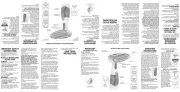
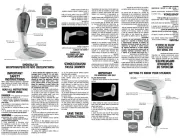
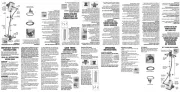
GETTING TO KNOW YOUR STEAMER
1. Make sure the unit is unplugged.
2. Stand the unit on a table and grasp
3. With other hand, move the release switch up
4. Pull the reservoir out, away from the steamer
5. The rubber inlet cover is located on the top
6. Open the inlet cover and fill the reservoir with
distilled water (which can be found in grocery
We recommend that you use distilled water
only, as this will prevent mineral deposits in the
boiler that can reduce performance or clog the
7. Close the inlet cover and return the reservoir
to its proper posititon, making sure that it snaps
Steam setting indicator lights
1. Fill water reservoir with distilled water.
2. Plug the unit into the electrical outlet.
3. Press the ON/OFF button to turn steamer ON.
4. The blue READY light will illuminate and
begin blinking. Allow 40 seconds for the unit to
warm up. The appliance is ready to use when
the READY light stops blinking and remains
solid. NOTE: Before first use or when the unit
has not been used for a long period of time, it
will be necessary to prime (i.e., fill with water)
the internal tank while the steamer prepares
to steam. You may hear a small tapping noise
during the heat-up process; this is normal.
steam settings. Press the
SETTING button repeatedly
until you reach your desired
delicate fabrics, while 5
red lights indicate TURBO
thicker fabrics and heavily wrinkled articles.
Always have the steam facing away from
you or anyone else in the room.
6. Press STEAM button to release the flow of
7 . To stop the flow of steam, depress the
8. When first using the device, test on an old
cloth, as there may be sediment left from the
manufacturing process or transportation.
9. Press ON/OFF button to turn unit OFF.
10. Unplug the device when it is not in use.
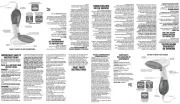
a built-in creaser on the top
of the unit. To use, slide
garment under the clip and
align edge with the pattern
as marked on the creaser.
and steam will issue from
the port on the top of the
unit. Slide the steamer along
the edge of the garment to
create a sharp crease. NOTE:
Steam will continue to emit
from the steam nozzle on the front of the unit
head, ensuring it is firmly
affixed. At this point, the
Silicone Band can be used
or you can choose to affix
insert (Fig. 2) or Delicate
Fabric Spacer (Fig. 3) insert
one function of the 3-in-1
attachment can be used at
18. No ponga la mano frente al vapor.
19. Para evitar las sobrecargas eléctricas, no
conecte otro aparato de alta potencia al mismo
20. Tenga cuidado al instalar/sacar accesorios,
puesto que pueden estar calientes o contener
agua caliente. Cerciórese de que el aparato está
apagado y de que los accesorios están secos y
fríos antes de manipularlos.
21. Nunca use el aparato en prendas que usted
o alguien lleven puestas.
22. El vapor que sale de la boquilla durante el
uso puede causar quemaduras si usa la unidad
muy cerca de la piel, del cuero cabelludo o
de los ojos, o si la usa en forma incorrecta.
Para reducir el riesgo de quemaduras, pruebe
el vapor lejos de su cuerpo antes de usar el
Al usar aparatos eléctricos, especialmente
en presencia de niños, siempre debe tomar
precauciones básicas de seguridad, entre ellas
PELIGRO – Cualquier aparato
enchufado permanece bajo tensión, aunque
Para reducir el riesgo de electrocución:
1. Siempre desenchufe el aparato
inmediatamente después del uso y antes
2. No coloque ni guarde el aparato donde pueda
caerse o ser empujado a una bañera o un
3. No coloque el aparato ni lo deje caer al agua
4. No trate de alcanzar el aparato después
de que se haya caído al agua; desenchúfelo
5. Utilícelo solamente en un lugar seco.
ADVERTENCIA – Para reducir el
riesgo de quemaduras, electrocución, incendio
1. Nunca descuide/deje el aparato sin
vigilancia mientras está conectado.
2. Este aparato no es un juguete; no debe
3. Supervise el uso de este aparato
cuidadosamente cuando sea usado cerca de
niños o personas con ciertas discapacidades.
El uso sin supervisión de este aparato puede
causar un incendio o una herida.
4. Utilice este aparato únicamente con el
propósito para el cual fue diseñado y solamente
según las instrucciones. Solo use accesorios
recomendados por el fabricante.
5. Ponga la base del aparato sobre una
superficie llana y segura.
6. No utilice este aparato si el cable o el
enchufe están dañados, si no funciona
correctamente, si está dañado, o después
de que se haya caído, incluso en el agua;
No intente reparar el aparato. El ensamblar
las partes de manera incorrecta aumenta
los riesgos de incendio, descarga eléctrica
y heridas. regréselo a un centro de servicio
autorizado para su revisión y reparación.
7. Mantenga el cable alejado de superficies
calientes. No permita que el cable tenga
contacto con superficies calientes. No jale ni
retuerza el cable. Permita que el aparato se
enfríe completamente antes de guardarlo.
Enrolle el cable sin apretar alrededor del
8. Para reducir el riesgo de descarga eléctrica,
el cable de este aparato está dotado de un
enchufe polarizado (una pata es más ancha
que la otra). Como medida de seguridad, se
podrá enchufar de una sola manera en la
toma de corriente polarizada. Si no entra en
la toma de corriente, inviértalo. Si aun así no
entra completamente, comuníquese con un
electricista. No intente ir en contra de esta
9. Nunca deje caer ni inserte ningún objeto en
ninguna de las aberturas.
10. No utilice el aparato en exteriores, ni
lo haga funcionar donde se estén usando
productos en aerosol (spray) o donde se esté
11. Si debe usar el aparato con una extensión,
utilice una extensión de 15 amperios. Una
extensión de menor amperaje podría calentar
excesivamente. Coloque la extensión de manera
que nadie la pueda jalar o tropezar con ella.
12. Las superficies de este aparato se ponen
muy calientes durante el uso; mantenga los ojos
y la piel alejados de las superficies calientes.
13. No coloque la boquilla sobre ninguna
superficie mientras está caliente o mientras el
aparato está conectado, y manténgala alejada
14. Siempre desenchufe el aparato antes de
llenar o vaciar el depósito de agua, y cuando
15. Siempre llene el depósito de agua con agua
destilada antes de encender el aparato.
16. Nunca jale el cable para desconectar el
aparato; agárrelo por la clavija.
17. Las piezas calientes, el agua caliente y
el vapor pueden causar quemaduras. Tenga
cuidado al vaciar el depósito de agua o al
voltear el aparato, puesto que el depósito
puede contener agua caliente. Siempre oriente
la boquilla de tal manera que el vapor no esté
dirigido a nadie, incluso al encender el aparato.
FAMILIARÍCESE CON SU VAPORIZADOR DE PRENDAS
1. Cerciórese de que el aparato está
2. Coloque la unidad sobre una mesa y agárrela
3. Con la otra mano, deslice el botón de
liberación del depósito de agua hacia el botón
4. Saque el depósito de agua.
5. Localice el tapón de caucho ubicado arriba
6. Abra el tapón de caucho y llene el depósito
con agua destilada (disponible en la mayoría de
Nota: a fin de evitar los depósitos minerales,
los cuales pueden perjudicar el rendimiento
del aparato o tapar el sistema de vaporización,
le aconsejamos que use agua destilada
7. Cierre el tapón y vuelva a instalar el depósito
1. Llene el depósito de agua con agua
2. Enchufe el aparato en una toma de corriente.
3. Oprima el botón de encendido/apagado para
4. La luz azul “READY” se encenderá y
empezará a parpadear. Permita que la unidad
se caliente por 40 segundos. El aparato está
listo cuando la luz “READY” deja de parpadear y
permanece encendida. antes del primer NOTA:
uso o cuando la unidad no haya sido usada
por un tiempo prolongado, el depósito interno
se cebará (se llenará con agua) durante el
calentamiento. Escuchará un pequeño golpeteo;
SETTING para elegir el nivel
mínimo, para uso en telas
delicadas, mientras 5 luces
rojas corresponden a la función “turbo” para
uso en telas gruesas y artículos arrugados.
Siempre oriente la boquilla de tal manera
que el vapor no esté dirigido a nadie.
6. Oprima el botón STEAM para producir vapor.
7. Suelte el botón STEAM para detener el flujo
8. Antes del primer uso, haga una prueba
en un trapo para eliminar el polvo y otros
residuos acumulados durante la fabricación y el
9. Oprima el botón de encendido/apagado para
10. Desenchufe la unidad cuando no está en uso.
Su vaporizador de prendas
prenda por debajo del clip,
alineando el borde con el
estampado según se indica
en la unidad. Presione el
saldrá por el puerto arriba
vaporizador a lo largo del
crear un pliegue preciso. durante este NOTA:
proceso, el vapor seguirá saliendo por la