STANDARD EQUIPMENT
WARNING! Read all safety warnings, instructions, illustrations and specifications provided with this
power tool. Failure to follow all instructions listed below may result in electric shock, fire and/or serious
injury.
Save all warnings and instructions for future reference.
The term “power tool” in the warnings refers to your mains-operated (corded) power tool or battery-operated
(cordless) power tool.
1) Work area safety
a) Keep work area clean and well lit. Cluttered or dark areas invite accidents.
b) Do not operate power tools in explosive atmospheres, such as in the presence of flammable liquids,
gases or dust. Power tools create sparks which may ignite the dust or fumes.
c) Keep children and bystanders away while operating a power tool. Distractions can cause you to lose
control.
2) Electrical safety
a) Power tool plugs must match the outlet. Never modify the plug in any way. Do not use any adapter
plugs with earthed (grounded) power tools. Unmodified plugs and matching outlets will reduce risk of
electric shock.
b) Avoid body contact with earthed or grounded surfaces, such as pipes, radiators, ranges and
refrigerators. There is an increased risk of electric shock if your body is earthed or grounded.
c) Do not expose power tools to rain or wet conditions. Water entering a power tool will increase the risk
of electric shock.
d) Do not abuse the cord. Never use the cord for carrying, pulling or unplugging the power tool. Keep
cord away from heat, oil, sharp edges or moving parts. Damaged or entangled cords increase the risk
of electric shock.
e) When operating a power tool outdoors, use an extension cord suitable for outdoor use. Use of a cord
suitable for outdoor use reduces the risk of electric shock.
f) If operating a power tool in a damp location is unavoidable, use a residual current device (RCD)
protected supply. Use of an RCD reduces the risk of electric shock.
3) Personal safety
a) Stay alert, watch what you are doing and use common sense when operating a power tool. Do not use
a power tool while you are tired or under the influence of drugs, alcohol or medication. A moment of
inattention while operating power tools may result in serious personal injury.
b) Use personal protective equipment. Always wear eye protection. Protective equipment such as a dust
mask, non-skid safety shoes, hard hat or hearing protection used for appropriate conditions will reduce
personal injuries.
c) Prevent unintentional starting. Ensure the switch is in the off-position before connecting to power
source and/or battery pack, picking up or carrying the tool. Carrying power tools with your finger on
the switch or energising power tools that have the switch on invites accidents.
d) Remove any adjusting key or wrench before turning the power tool on. A wrench or a key left attached
to a rotating part of the power tool may result in personal injury.
e) Do not overreach. Keep proper footing and balance at all times. This enables better control of the
power tool in unexpected situations.
f) Dress properly. Do not wear loose clothing or jewellery. Keep your hair and clothing away from moving
parts. Loose clothes, jewellery or long hair can be caught in moving parts.
g) If devices are provided for the connection of dust extraction and collection facilities, ensure these are
connected and properly used. Use of dust collection can reduce dust-related hazards.
h) Do not let familiarity gained from frequent use of tools allow you to become complacent and ignore
tool safety principles. A careless action can cause severe injury within a fraction of a second.
4) Power tool use and care
a) Do not force the power tool. Use the correct power tool for your application. The correct power tool
will do the job better and safer at the rate for which it was designed.
b) Do not use the power tool if the switch does not turn it on and off. Any power tool that cannot be
controlled with the switch is dangerous and must be repaired.
c) Disconnect the plug from the power source and/or remove the battery pack, if detachable, from
the power tool before making any adjustments, changing accessories, or storing power tools. Such
preventive safety measures reduce the risk of starting the power tool accidentally.
d) Store idle power tools out of the reach of children and do not allow persons unfamiliar with the
power tool or these instructions to operate the power tool. Power tools are dangerous in the hands of
untrained users.
e) Maintain power tools and accessories. Check for misalignment or binding of moving parts, breakage
of parts and any other condition that may affect the power tool’s operation. If damaged, have the
power tool repaired before use. Many accidents are caused by poorly maintained power tools.
f) Keep cutting tools sharp and clean. Properly maintained cutting tools with sharp cutting edges are less
likely to bind and are easier to control.
g) Use the power tool, accessories and tool bits etc. in accordance with these instructions, taking into
account the working conditions and the work to be performed. Use of the power tool for operations
different from those intended could result in a hazardous situation.
h) Keep handles and grasping surfaces dry, clean and free from oil and grease. Slippery handles and
grasping surfaces do not allow for safe handling and control of the tool in unexpected situations.
5) Battery tool use and care
a) Recharge only with the charger specified by the manufacturer. A charger that is suitable for one type of
battery pack may create a risk of fire when used with another battery pack.
b) Use power tools only with specifically designated battery packs. Use of any other battery packs may
create a risk of injury and fire.
c) When battery pack is not in use, keep it away from other metal objects, like paper clips, coins, keys,
nails, screws or other small metal objects, that can make a connection from one terminal to another.
Shorting the battery terminals together may cause burns or a fire.
d) Under abusive conditions, liquid may be ejected from the battery; avoid contact. If contact accidentally
occurs, flush with water. If liquid contacts eyes, additionally seek medical help. Liquid ejected from the
battery may cause irritation or burns.
e) Do not use a battery pack or tool that is damaged or modified. Damaged or modified batteries may
exhibit unpredictable behaviour resulting in fire, explosion or risk of injury.
f) Do not expose a battery pack or tool to fire or excessive temperature. Exposure to fire or temperature
above 130 °C may cause explosion.
g) Follow all charging instructions and do not charge the battery pack or tool outside the temperature
range specified in the instructions. Charging improperly or at temperatures outside the specified range
may damage the battery and increase the risk of fire.
6) Service
a) Have your power tool serviced by a qualified repair person using only identical replacement parts. This
will ensure that the safety of the power tool is maintained.
b) Never service damaged battery packs. Service of battery packs should only be performed by the
manufacturer or authorized service providers.
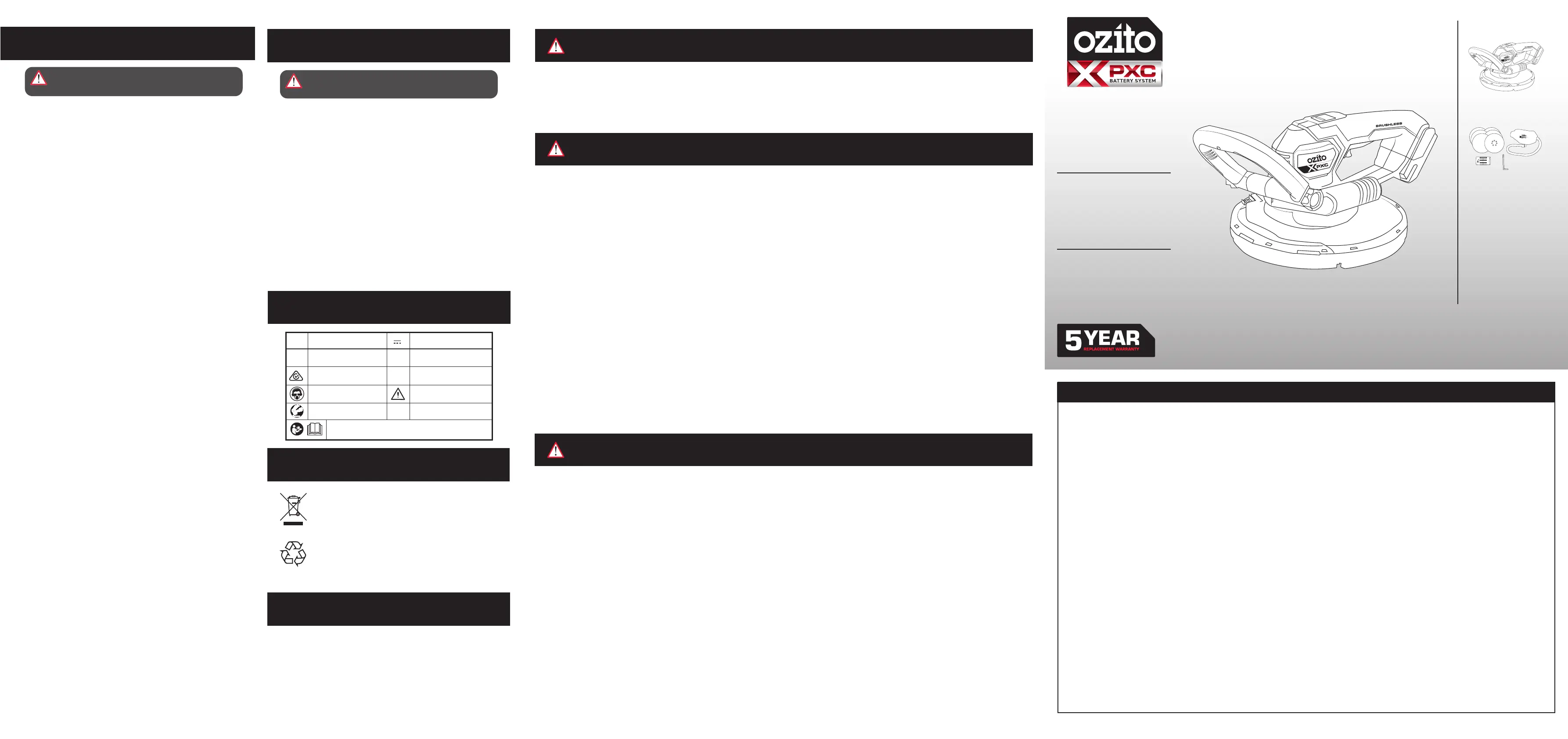
PXBDWS-225
INSTRUCTION MANUAL
SPECIFICATIONS
Input: 18V
No Load Speed: 600-1200/min
Sanding Surface: Ø225mm
Hose Length: 4,500mm
Dust Extraction Port Size: Ø35mm
Weight: 2.36kg
ozito.com.au
0725
GENERAL POWER TOOL SAFETY WARNINGS
ELECTRICAL SAFETY
DRYWALL SANDER SAFETY WARNINGS
Brushless Drywall Sander
6 x Sanding Disc (2 x 120Grit),
2 x 80Grit), 2 x 60Grit), Dust
Bag, Exaction Hose, Dust
Extraction Adaptor, Allen Key
MAINTENANCE
DESCRIPTION OF SYMBOLS
Warning
Operate with two hands
Regulatory Compliance Mark
(RCM)
Wear eye, ear & breathing
protection
V
Volts
Ø
Diameter
mm
Millimetre
Direct Current
/min
Per minute
No Load Speed
Read Instruction Manual
⁰
n
Power tools that are no longer usable should not be disposed
of with household waste but in an environmentally friendly
way. Please recycle where facilities exist. Check with your local
council authority for recycling advice.
Recycling packaging reduces the need for landll and raw
materials. Reuse of recycled material decreases pollution in the
environment. Please recycle packaging where facilities exist.
Check with your local council authority for recycling advice.
CARING FOR THE ENVIRONMENT
SPARE PARTS
Spare parts can be ordered from the Special Orders
Desk at your local Bunnings Warehouse.
For further information, or any parts not listed here,
visit www.ozito.com.au or contact Ozito Customer
Service:
Australia 1800 069 486
New Zealand 0508 069 486
E-mail: enquiries@ozito.com.au
BRUSHLESS
DRYWALL
SANDER
IN ORDER TO MAKE A CLAIM UNDER THIS WARRANTY YOU
MUST RETURN THE PRODUCT TO YOUR NEAREST BUNNINGS
WAREHOUSE WITH YOUR BUNNINGS REGISTER RECEIPT. PRIOR TO
RETURNING YOUR PRODUCT FOR WARRANTY PLEASE TELEPHONE
OUR CUSTOMER SERVICE HELPLINE:
Australia 1800 069 486
New Zealand 0508 069 486
WARRANTY
TO ENSURE A SPEEDY RESPONSE PLEASE HAVE THE MODEL
NUMBER AND DATE OF PURCHASE AVAILABLE. A CUSTOMER
SERVICE REPRESENTATIVE WILL TAKE YOUR CALL AND
ANSWER ANY QUESTIONS YOU MAY HAVE RELATING TO THE
WARRANTY POLICY OR PROCEDURE.
OZITO 25 Fox Drive, Dandenong South, VIC 3175, Australia.
The benets provided under this warranty are in addition to other rights and
remedies which are available to you at law.
Our goods come with guarantees that cannot be excluded at law. You are entitled to
a replacement or refund for a major failure and for compensation for any other
reasonably foreseeable loss or damage. You are also entitled to have the goods
repaired or replaced if the goods fail to be of acceptable quality and the failure
does not amount to a major failure.
Generally you will be responsible for all costs associated with a claim under this
warranty, however, where you have suffered any additional direct loss as a result of
a defective product you may be able to claim such expenses by contacting our
customer service helpline above.
WARNING
The following actions will result in the warranty being
void.
• If the tool has been operated on a supply voltage other than that specied
on the tool.
• If the tool shows signs of damage or defects caused by or resulting from
abuse, accidents or alterations.
• Failure to perform maintenance as set out within the instruction manual.
• If the tool is disassembled or tampered with in any way.
5 YEAR REPLACEMENT WARRANTY
Your Product is guaranteed for a period of 60 months from the original date of
purchase and is intended for DIY (Do It Yourself) use only. If a product is defective it
will be replaced in accordance with the terms of this warranty. Lithium Ion
batteries and chargers are covered by a 36 month
warranty and are excluded from the warranty extension. Warranty excludes
consumable parts.
WARNING! ENSURE THE TOOL IS SWITCHED
OFF AND THE BATTERY IS REMOVED BEFORE
PERFORMING ANY OF THE FOLLOWING TASKS.
WARNING! BEFORE CLEANING OR CARRYING OUT
ANY MAINTENANCE PROCEDURE, ENSURE THAT
THE BATTERIES HAVE BEEN REMOVED.
WARNING! When using electric tools basic safety precautions should always be followed to reduce
the risk of fire, electric shock and personal injury.
• Read the whole manual carefully and make sure you know how to switch the tool off in an
emergency, before operating the tool. Save these instructions and other documents supplied
with this tool for future reference.
• -This appliance is not intended for use by persons (including children) with reduced physical,
sensory or mental capabilities, or lack of experience and knowledge, unless they have been
given supervision or instruction concerning use of the appliance by a person responsible for
their safety.
• Children should be supervised to ensure that they do not play with the appliance.
• This appliance is compatible and only to be used with all batteries & chargers from the Ozito
PXC range. Refer to the PXC battery and charger manuals for information regarding charging,
use and storage.
WARNING! Always remove the battery from the tool:
• when the batteries are to be charged,
• when the tool is left unattended,
• when the tool is being checked, cleaned, or having maintenance work done,
• when the tool is to be stored, or if the tool vibrates abnormally.
• Do not combine different types of batteries or new and used batteries.
• Do not use modified or damaged batteries.
WARNING! The appliance is not to be used by persons (including children) with reduced physical, sensory
or mental capabilities, or lack of experience and knowledge, unless they have been given supervision or
instruction.
Young children should be supervised to ensure that they do not play with the appliance.
a) This power tool is intended to function as a sander. Read all safety warnings, instructions, illustrations
and specifications provided with this power tool. Failure to follow all instructions listed below may result in
electric shock, fire and/or serious injury.
b)Operations such as grinding, wire brushing, polishing, hole cutting or cutting-off are not to be
performed with this power tool. Operations for which the power tool was not designed may create a hazard
and cause personal injury.
c) Do not convert this power tool to operate in a way which is not specifically designed and specified by
the tool manufacturer. Such a conversion may result in a loss of control and cause serious personal injury.
d) Do not use accessories which are not specifically designed and specified by the tool manufacturer.
Just because the accessory can be attached to your power tool, it does not assure safe operation.
e) The rated speed of the accessory must be at least equal to the maximum speed marked on the power
tool. Accessories running faster than their rated speed can break and fly apart.
f) The outside diameter and the thickness of your accessory must be within the capacity rating of your
power tool. Incorrectly sized accessories cannot be adequately guarded or controlled.
g) The dimensions of the accessory mounting must fit the dimensions of the mounting hardware of the
power tool. Accessories that do not match the mounting hardware of the power tool will run out of balance,
vibrate excessively and may cause loss of control.
h) Do not use a damaged accessory. Before each use inspect the accessory such as abrasive wheels for
chips and cracks, backing pad for cracks, tear or excess wear, wire brush for loose or cracked wires. If
power tool or accessory is dropped, inspect for damage or install an undamaged accessory. After inspecting
and installing an accessory, position yourself and bystanders away from the plane of the rotating accessory
and run the power tool at maximum no-load speed for one minute. Damaged accessories will normally break
apart during this test time.
i) Wear personal protective equipment. Depending on application, use face shield, safety goggles or
safety glasses. As appropriate, wear dust mask, hearing protectors, gloves and workshop apron capable
of stopping small abrasive or workpiece fragments. The eye protection must be capable of stopping flying
debris generated by various applications. The dust mask or respirator must be capable of filtrating particles
generated by the particular application. Prolonged exposure to high
intensity noise may cause hearing loss.
j) Keep bystanders a safe distance away from work area. Anyone entering the work area must wear
personal protective equipment. Fragments of workpiece or of a broken accessory may fly away and cause
injury beyond immediate area of operation
k) Position the cord clear of the spinning accessory. If you lose control, the cord may be cut or snagged
and your hand or arm may be pulled into the spinning accessory.
l) Never lay the power tool down until the accessory has come to a complete stop. The spinning
accessory may grab the surface and pull the power tool out of your control.
m) Do not run the power tool while carrying it at your side. Accidental contact with the spinning accessory
could snag your clothing, pulling the accessory into your body.
n) Regularly clean the power tool’s air vents. The motor’s fan will draw the dust inside the housing and
excessive accumulation of powdered metal may cause electrical hazards.
o) Do not operate the power tool near flammable materials. Sparks could ignite these materials.
p) Do not use accessories that require liquid coolants. Using water or other liquid coolants may result in
electrocution or shock.
Kickback is a sudden reaction to a pinched or snagged rotating wheel, backing pad, brush or
any other accessory. Pinching or snagging causes rapid stalling of the rotating accessory
which in turn causes the uncontrolled power tool to be forced in the direction opposite of the
accessory’s rotation at the point of the binding.
For example, if an abrasive wheel is snagged or pinched by the workpiece, the edge of the wheel that is
entering into the pinch point can dig into the surface of the material causing the wheel to climb out or kick
out. The wheel may either jump toward or away from the operator, depending on direction of the wheel’s
movement at the point of pinching. Abrasive wheels may also break under these conditions.
Kickback is the result of power tool misuse and/or incorrect operating procedures or conditions and can
be avoided by taking proper precautions as given below.
a) Maintain a firm grip with both hands on the power tool and position your body and arms to allow
you to resist kickback forces. Always use auxiliary handle, if provided, for maximum control over kickback
or torque reaction during start-up. The operator can control torque reactions or kickback forces, if proper
precautions are taken.
b) Never place your hand near the rotating accessory. Accessory may kickback over your hand.
c) Do not position your body in the area where power tool will move if kickback occurs. Kickback will
propel the tool in direction opposite to the wheel’s movement at the point of snagging.
d) Use special care when working corners, sharp edges, etc. Avoid bouncing and snagging the accessory.
Corners, sharp edges or bouncing have a tendency to snag the rotating accessory and cause loss of control
or kickback.
e) Do not attach a saw chain woodcarving blade, segmented diamond wheel with a peripheral gap
greater than 10 mm or toothed saw blade. Such blades create frequent kickback and loss of control.
Use proper sized sanding disc paper. Follow manufacturers recommendations, when selecting sanding
paper. Larger sanding paper extending too far beyond the sanding pad presents a laceration hazard and may
cause snagging, tearing of the disc or kickback.
Disposing of dust. Be extremely careful of dust disposal, materials in fine particle form may be explosive. Do
not throw sanding dust on an open fire. Spontaneous combustion, may in time, result from a mixture of oil or
water with dust particles.
Always wear eye protection and a dust mask for dusty applications and when sanding overhead. Sanding
particles can be absorbed by your eyes and inhaled easily and may cause health complications.
Use special precautions when sanding chemically pressure treated timber, paint that may be lead based,
or any other materials that may contain carcinogens. A suitable breathing respirator and protective
clothing must be worn by all persons entering the work area. Work should be sealed by plastic sheeting and
persons not protected should be kept out until work area is thoroughly cleaned.
Do not ‘wet sand’ with this sander. Liquids entering the motor housing are an electrical shock hazard.
Avoid using power tools for long periods of time without breaks. Vibration from tools can be transmitted into
your hands and arms.
WARNING! Some dust created by power sanding, sawing, grinding, drilling and other construction
activities contain chemicals known to cause cancer, birth defects or other reproductive harm.
Some examples of these chemicals are:
- Lead from lead-based paints;
- Crystalline silica from bricks, cement and other masonry products, and;
- Arsenic and chromium from chemically-treated timber.
Your risk from these exposures varies, depending on how often you do this type of work. To reduce your
exposure to these chemicals: work in a well ventilated area and work with approved safety equipment, such
as dust masks that are specially designed to filter out microscopic particles.
Cleaning
• Keep the ventilation slots of the tool clean at all times to ensure efcient
operation.
• After each use, blow air through the tool housing to ensure it is free from
all dust, dirt, etc. Build up of dust or dirt particles may cause the tool to
overheat and shorten the life of the tool.
• If the housing of the tool requires cleaning, do not use solvents. Use of a
cloth only is recommended.
• Never allow any liquid to get inside the tool, never immerse any part of
the tool into liquid.
Storage
When not in use, the tool should be stored in a dry, frost free location, keep
out of children’s reach.
Note: Ozito Industries will not be responsible for any damage or
injuries caused by repair of the tool by an unauthorised person or by
mishandling.
Short Battery Runtime
Ensure the battery is properly charge. It will take 4-5 charging cycles before
the battery reaches optimum charge and run time.
Sanding Disc not sanding
If the sanding disc is no longer sanding, please change the sanding disc.
TROUBLESHOOTING