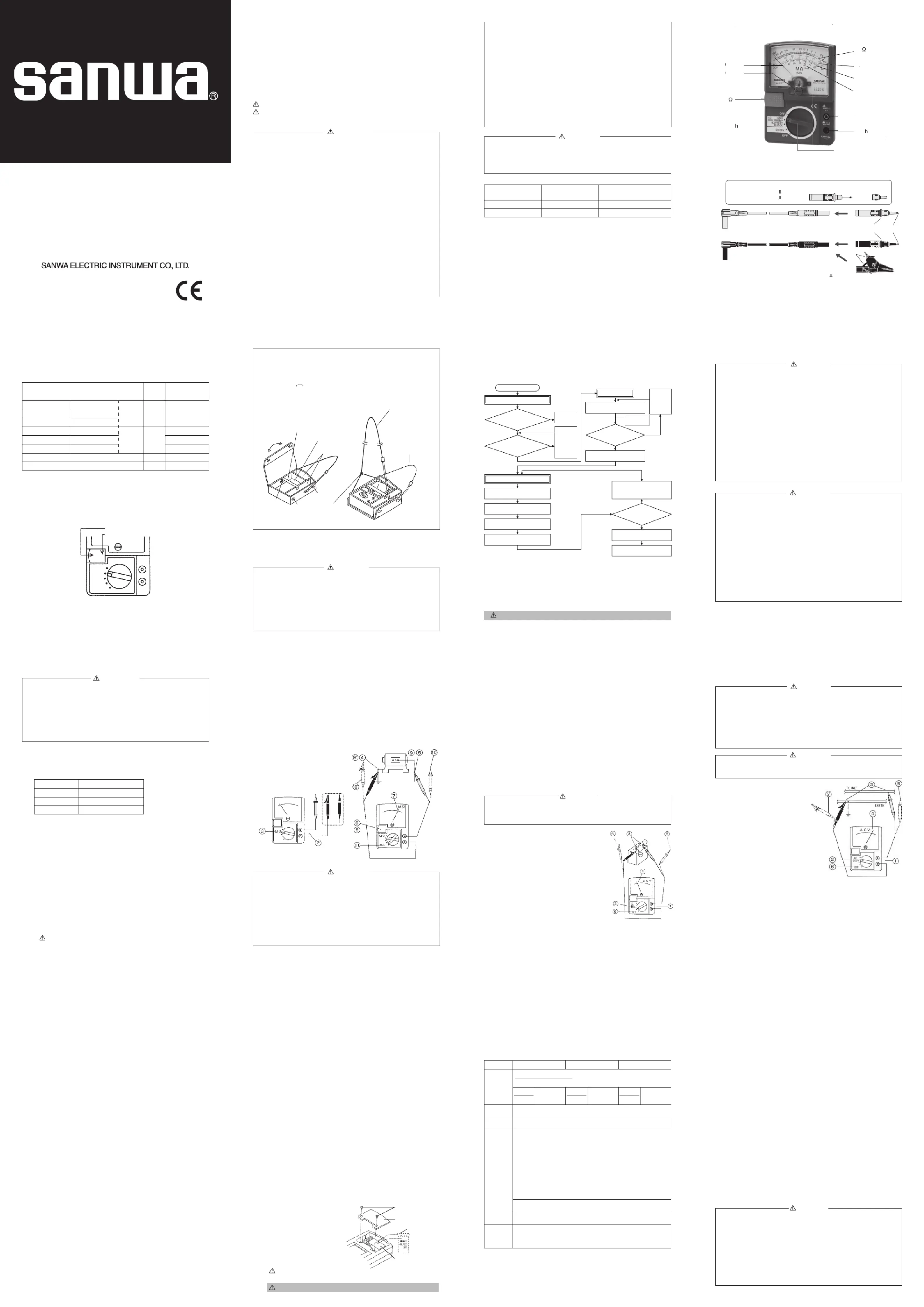
INSULATION RESISTANCE TESTER
Dempa Bldg., 4-4 Sotokanda 2-Chome
To ensure that the meter is used safely, follow all safety and operating instructions.
11. Never use tester for high power or high voltage circuit.
y special attention when measuring the voltage of AC 33 Vrms
(46.7 V Peak) or DC 70 V or more to avoid injury.
13. Disconnect power source of the measured circuit before
measuring insulation resistance.
14. High voltage is generated while measuring insulation resistance.
Be cautions of electric shock.
15. After measuring insulation to avoid electric shock. Be sure to
discharge the high voltage charged.
Never apply an input signal exceeding the maximum rating input value.
17. Nev f her use tester or measuring the line connected wit
equipment (i.e. motors) that generates induced or surge voltage
since it may exceed the maximum allowable voltage.
18. Never use tester if the tester or test leads are damaged or broken.
19. Never use uncased tester.
Always keep your ngers behind the Barriers on the probe when
【 】1 Read First: Safety Information
We thank you for your purchasing our product, the battery-driven
insulation resistance tester.
This is a DC resistance tester developed under the principle to provide
new and unique design and function f or the measurement of insulatio n
resis ance of ea kind of electric equipments. Since this testet ch r
generates high voltage, p1-we recommend that you read this instruction
manual thoroughly, and treat the tester correctly and safely.
The symbols used on this tester and in this instruction manual denote
Be careful as the high voltage is impressed.
Be careful because there is a possibility of bodily injury or the
destruction of equipment.
Be sure to disconnect the test pin from the circuit when changing the function.
12. Never use tester with wet hands or in a damp environment.
Do not attempt any alterations of original specications.15.
To ensure safety and maintain accuracy, calibrate and check the
tester at least once a year.
Maximum Overload Protection Input
ACV (600) AC 600 V AC 720 V
DCV (60) DC 60 V AC 600 V
【 】2 Applications and Features
・DC insulation resistance tester to measure the insulation resistance
of electric lines and electric equipment.
Remove components such as semi-conductors and apparatuses from the circuit of
measuring object to avoid damages when withstand of the object is unknown or
lower than rated measuring voltage of a resistance insulation tester, especially in
case of the objects you me re neasu con ct h P r c ut s.ed wit Cs o omp er
The measured voltage is maintained until the low insulation resistance
value at the rated current specied in IEC61557-2.
Do not use the instrument in a place where corrosive or explosive
To prevent the protection function of the tester from being spoiled,
do not use it in a method other than specied.
・It is equipped with the discharge function.
・It is equipped with the (insulation resis ance) M Ω t measuring swit ch
that enables both one-shot and continuous measurement.
When handling equipment containing a hazardous live part, be
sure to wear insulative protection gear to prevent accidents. Also
be sure to observe your local and national safety regulations.
Use test leads matching the measurement category of the object
measured. If the measurement categories of the instrument and test leads
were different, the lowest measurement category would be applied.
Removable test pin covers
【 】4 Description of Functions
・Function control knob and MΩ (insulation resis ance)t measuring switch
by two coperating these swit hes, the functions and ranges can be
Position of Function Control Knob
The M measuring switch is turned on by the following operation.Ω
①ON only when the right end of the lev er is pressed with a nger.
(OFF when the nger is released)
②Continuously ft levON when the le end of the er is raised. (OF F
・Meter zero position adjustment
If t m er ter is n he et poin ot on the
gra dua onti line of the sc M Ωale
when the function control knob is at OF F, z nadjust the ero positio
1. Do not use a damaged tester or test lead.
2. Make sure test lead wiring is not broken.
3. When testing the continuity of a test lead, the measuring terminals
are under a high voltage. Be careful of electric shock.
4. To ev ck tpr ent electric sho and ba te consumption, be surery to
turn the M ch function control knob to OFFΩmeasuring swit and
During measurement, set the case as illustrated and hang it from
direction at pi vot the A.
Before star ng c ck t ti me urement,as he he“appearance”,“point 0er
), “ ” battery and “ ” measuring lead in this order. (*The pointer
0 position is the 0 position of the DC 60 V scale or
Check appearance and pointer 0 position.
Turn function control knob
to DC 60 V/BATTERY CHECK.
Pointer is on left of battery
Turn function control knob
Check measuring lead wiring breakage.
Connect black test lead to EARTH terminal
and red test lead to LINE terminal.
Turn function control knob to
Turn on MΩ measuring switch.
Release push switch and replace test
lead with new one and re-check.
If replacement does not work, repair
Turn MΩ measuring switch and
function control knob to OFF.
Normal. Proceed to measurement.
Pointer is at almost 0 MΩ
position of insulation resistance
5.2 How to Check Battery (BATTERY CHECK)
Prior to MΩ (insulation resis ance) measurement, t be sure to check eth
battery. A consumed battery will cause not only measurement errors
but danger due to erroneous measurement.
For checking methods, refer to 5.1 Start-up Check.
Do not check the battery for more than 5 seconds.
Short alligator clip (or test pin) on black
test lead with test pin on red test lead.
1. Never apply a voltage to the measuring terminal when the tester
is in the MΩ measuring range.
2. P rior to measurement, disconnect the measuring object (circuit )
3. Prior to measurement, ma sure no ol age is applied to th ke v t e
circuit to measure by the AC 600 V range.
4. During measurement, a high voltage is generated. Do not touch
the test pin, clip and measuring object.
The tester and measured circuit have been charged by high voltage
immediately after the measurement. Be careful not to get electric
6. T a ty c Afhere is possibili of an accident of electric sho k. ter th e
mea rem di ge highsu en be e to t, sur schar the voltage charged in
the measuring object. (See 5.4 Discharge Function)
5.3 Measurement of M (Insulation Resistance) Ω
When the object measured is grounded, usually connect the black
EARTH (ground) test lead to the grounded side and the red LINE
test lead to the circuit. (When this connection is used, a measurement
v a v e obtained by the reverse alue becomes smaller than alu
2. To ev a er r, k topr ent measuring ro eep the test lead connected
the LINE side out of con actt with the measuring object and ground
he insulation resistance varies largely depending on temperature
a h ty. nd umidi It is also inue ednc by a volt to ap age ply (measuring
Normally as tempera ure, humidi and ol age increase, th t ty v t e
insulation resistance decreases.
The M measurement should be performed as quickly as possibleΩ
to prevent the internal parts from heating. Particularly, when measuring
resistance between 0 M to the center of scale, perform each Ω
measurement within 20 seconds and leave an equivalent interval to
the measuring time before proceeding to the subsequent measurement.
2. The no-load voltage is within 1.25 times the rated measuring
Measurement of insulation resis ance t (M
2) Rated measuring voltage
3) Selection of a measuring range
Turn the function control knob to (M ) / AC 600 V position.Ω
①Power off the measuring object.
③Turn the function control knob to a desired rated measuring
CAUTION : If the meter deects in this state, the measuring
object is charged. Be sure to rem e the voltageov
Insert the black measuring cord to which the black alligator clip (or
black pin-type adapter) is attached into the EARTH (ground)
measuring terminal, and the red measuring cord to which the red
pin-type adapter is attached into the LINE measuring terminal.
Connect the black alligator clip to the object measured. Usually
connect the EARTH (ground) measuring terminal to the grounding
Connect the tip of the red pin-type adapter to the other side of
⑥Turn on the M measuring switch.Ω
(See [4] Description of Functions)
⑦Read the indicated value. Use the MΩ scale.
⑧Turn off the MΩ measuring switch.
⑨Discharge the high vol aget charged in the measuring object. Se e
⑪Be re to turn the functi control knob to the position of OFF.su on
1. Rated measuring voltage should be selected by a measuring
object. For example, 125 V rated measuring voltage should be
used for the object, AC input voltage of which is 100 V.
2.Remove components such as semi-conductors and apparatuses
from the circuit of measuring object to oid damages whe av n
withstand of the object is unknown or lower than rated measuring
voltage of a resistance insulation tester, especially in case of the
objects you measure connected with PCs or computers.
First remove the red test pin from the object measured, and
then disconnect the black alligator clip.
1) Reason of a need to discharge
For safety, high voltage remaining in capacitive measuring objects
such as capacitors and electric wire must be discharged to prevent
2) Discharging method (This procedure follows the step ⑧ of 5.3-4)
① ΩWhen Mthe measurement has been completed, turn off only
the MΩmeasuring switch with the test pin and the alligator clip
connected to the measuring object.
②T hen the pointer deects to the right and its deection become s
smaller as time passes (indicating the charged charge is being
When the pointer stops at zero (
of the M scale) and dischargeΩ
has been completed, conduct the steps ⑩ and ⑪ of 5.3-4)
Measurement of DCV (DC voltage) (Measuring range is the DV 60 V range only)
1. a v t exDo not apply ol age ceeding the maximum rated ol age v t of
2. Keep in mind the warnings of 5.6 described earlier.
DC voltages of batteries, etc. can be measured.
Also, the tester can be used to check the presence
of DC voltage prior to M measurement. Ω
Turn the function control knob to DC 60 V.
④Read the indicated value on the DCV scale.
⑥Turn the function control knob to the position of OFF.
Insert the black measuring cord to which the black
alligator clip (or black pin-type adapter) is attached
into the EARTH (ground) measuring terminal, and the
red measuring cord to which the red pin-type adapter
is attached into the LINE measuring terminal.
Connect the black alligator clip to the
side of the object (circuit) measured,
and connect the tip of the red pin-type adapter to the side.+
First remove the red test pin from the object measured, and then
disconnect the black alligator clip from it.
Do not apply a voltage exceeding the maximum rated voltage of 600 VAC.
2. During measurement, do not operate the function control knob.
3. Do n mea a volt e with the M ch got sure ag Ωmeasuring swit bein
4. When the circuit to measure has brea a ker, vmeasure the ol agt e
on the secondary side (load side).
To prevent electric shock, do not touch the metal part of the pin plug and clip.
Measurement of ACV (AC voltage) (Measuring range is the AC 600 V range only)
AC voltages of waveforms other than wavef dsinusoidal orms an
frequencies other than 50 to 60 Hz erwill cause an indication ror.
Sinusoidal AC voltages (ACV)
such as lighting line voltages
②Turn the function control knob to AC 600 V.
④Read the indicated value on the ACV scale.
⑥Turn the function control knob to the position of OFF.
Insert the black measuring cord
to which the black alligator clip
(or black pin-type adapter) is
attached into the EARTH (ground)
measuring terminal, and the red
measuring cord to which the red
pin-type adapter is attached into
the LINE measuring terminal.
Connect the black alligator clip to the earth (grounding) side of
the object measured, and connect the tip of the red pin-type
adapter to the charging side of the object measured.
First remove the red test pin from the object measured, and
then disconnect the black alligator clip from it.
6-1 Warranty and Provision
Sanwa offers comprehensive warranty services to its end-users and to
its product resellers. Under Sanwa's general warranty policy, each
instrument is warranted to be free from defects in workmanship or
material under normal use for the period of one (1) year from the date
This warranty policy is valid within the country of purchase only, and
applied only to the product purchased from Sanwa authorized agent or
Sanwa reserves the right to inspect all warranty claims to determine
the xtent to whi e ch war ty y. Th war ty lthe ran policy shall appl is ran shal
not apply to test leads, disposables batteries, or any product or parts,
which have been subject to one of the following causes:
1. A f de eailure due to improper handling or use that viates from th
2. A failure due to inadequate repair or modication by people other
than Sanwa service personnel.
3. A failure due to causes not attributable to this product such as re,
ood and other natural disaster.
4. Non-operation due to a discharged battery.
A failure or damage due to transportation, relocation or dropping after
Customers are asked to provide the following information when
1. Customer name, address, and contact information
2. Description of problem
3. Description of product conguration
6. Proof of Date-of-Purchase
7. Where you purchased the product
①R ove t wo t ry dem ba te li
②Re a e n medpl ce th co su
batte thatry is connected to
③Set t r y ethe ba te in t h
original place and secure the
Be t ofsure to urn the function control knob to the position
OFF prior to replacing the battery.
Be sure to use the alkaline battery 6LR61(6LF22) (9 V).
1) Prior to requesting repair, please check the following:
Capacity of the battery, polarity of installation and discontinuity of the
2) Repair during the warranty period:
The failed meter will be repaired in accordance with the conditions
stipulated in 6-1 Warranty and Provision.
3) Repair after the warranty period has expired:
In some cases, repair and transportation cost may become higher
than the price of the product. Please contact Sanwa authorized agent
/ service provider in advance.
The minimum retention period of service functional parts is 6 years
after the discontinuation of manufacture. This retention period is the
repair warranty period. Please note, however, if such functional parts
become unavailable for reasons of discontinuation of manufacture,
etc., the retention period may become shorter accordingly.
4) Precautions when sending the product to be repaired
To ensure the safety of the product during transportation, place the
product in a box that is larger than the product 5 times or more in
volume and ll cushion materials fully and then clearly mark “Repair
Product Enclosed” on the box surface. The cost of sending and
returning the product shall be borne by the customer.
http://www.sanwa-meter.co.jp
E-mail: exp_sales@sanwa-meter.co.jp
8.1 Measurement Range and Accuracy
7.1 Accuracyassurance : 23± ℃ %5 75 RH max.
Model DM509S DM1009S PDM509S
Large numeral : 1st effective measuring scale
Small numeral : 2nd effective measuring scale
・ACV range (50/60 Hz sine e): wav ±5 % of full scale
・DCV range : ±5 % of full scale
±measurement range : 5 % of reading
±measurement range : 10 % of reading
scale : ±0.7 % of scale length
% of rated measuring voltage
Short circuit current : max 2.9 mA
*Factory-preinstalled battery
A batte orry f monitoring is preins alledt before shippin g, there oref it may
run do wn sooner than the battery life specied in the instruction manual .
The "battery for monitoring" is a battery to inspect the functions and
specications of the product.
Attitude: Horizontal ±5°. External magnetic eld: Not present.
: Within the range in which the battery Battery voltage
Within ±30 % (Maximum value tolerated by IEC standard)
Variation-causing factors [E1: Attitude. E2: Supply voltage.
Battery consumption : Checked by BATTERY CHECK range.
Allowable temperature/humidity range
: 23 5 , 75 % RH max., no condensation.± ℃
Service temperature/humidity
: 0 43 , 80 % RH max., no condensation.~ ℃
Storage temperature/humidity
50 ℃, 70 % RH max., no condensation.
Service ambient condition
Altitude 2000 m max., environmental pollution .Ⅱ
Layer built t ype alkaline ba te 6LR61(6LF22)t ry x V)1(9
: 2.0 W~2.8 W at MΩ range
When the lower limit measurement resistance value that
can maintain the rated output voltage is measured and
if one cycle for the measurement is dened as ON for 5
seconds and OFF for 25 seconds, the battery life is 500 cycles.
Accessories : Test lead TL-509S, 1 set
Instruction manual, 1 Carrying case C-09S, 1
・The panel and the case are not resistant to heat. Do not place the
instrument near heat-generating devices (such as a soldering iron).
・The panel and the case are not resistant to volatile solvent and
must not be cleaned with thinner or alcohol.
For cleaning, use dry, soft cloth and wipe it lightly.
・Do not store the instrument in a place where it may be subjected
to vibration or from where it may fall.
・For storing the instrument, avoid hot, cold or humid piaces or
places under direct sunlight or where condensation is anticipated.
8.2 General Specifications
AC rectifying method : Half-w e recticationav
(Mean value indication rms value converted)
Inner-pole type taut-band system, 24
Year of manufacture : The rst two digits of the serial number on
the bottom of this product indicate the last
, IEC61010-2-030 CAT.Ⅲ600 V *
EMC Directive, RoHS Directive
: IEC61326 (EMC), EN50581(RoHS)
Line from the primary side or branch of equipment which directly
takes in electricity from a distribution board to the receptacle.


