NAKS 28B-DBFF-1500 Manual

NAKS Emhætte 28B-DBFF-1500

Læs gratis den danske manual til NAKS 28B-DBFF-1500 (6 sider) i kategorien Emhætte. Denne vejledning er vurderet som hjælpsom af 24 personer og har en gennemsnitlig bedømmelse på 4.6 stjerner ud af 12.5 anmeldelser. Har du et spørgsmål om NAKS 28B-DBFF-1500, eller vil du spørge andre brugere om produktet?

Side 1/6
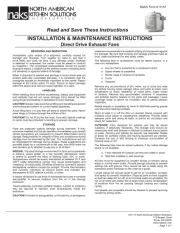
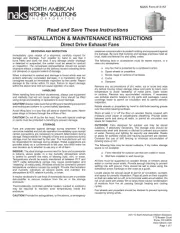
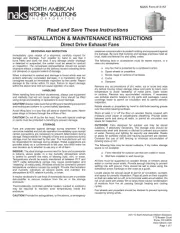
RECEIVING AND INSPECTION
Immediately upon receipt of a shipment, carefully inspect for damage
and shortage. Turn the impeller by hand to see that it turns freely
and does not bind. If any damage and/or shortage is detected or
suspected, the carrier must be asked to conduct an inspection. The
consignee’s representative should not accept a shipment without a
notation on the delivery receipt indicating items not delivered or the
apparent extent of damage.
When a shipment is opened and damage is found which was not
evident externally (concealed damage), it is mandatory that the
consignee request an immediate inspection by the carrier. Report any
damage to the carrier within 15 days. Failure to report damage within
the above time limit will result in rejection of a claim.
HANDLING
When handling fans and their accessories, always use equipment and
methods that will not cause damage. Fans should be lifted using slings
and padding or spreaders to avoid damage.
CAUTION! Always make sure that all lifting and handling equipment
and techniques conform to current safety standards.
Avoid lifting fans in a way that will bend or distort fan parts. Never pass
slings or timbers through the fan orice.
CAUTION! Do not lift by the fan hood. Fans with special coatings or
paints must be protected in handling to prevent damage.
STORAGE
Fans are protected against damage during shipment. If they cannot
be installed and put into operation immediately upon receipt certain
precautions are necessary to prevent deterioration during storage.
Responsibility for integrity of fans and accessories during storage must
be assumed by the user. The manufacturer will not be responsible
for damage during storage. These suggestions are provided solely as
a convenience to the user, who shall make his own decision as to
whether to use any or all of them.
INDOOR: The ideal storage environment for fans and accessories is
indoors, above grade, in a low humidity atmosphere which is sealed to
prevent the entry of blowing dust, rain, or snow. Temperatures should
be evenly maintained between 70°F and 105°F (wide temperature
swings may cause condensation and “sweating” of metal parts).
Windows should be covered to prevent temperature variations caused
by sunlight. Provide thermometers and humidity indicators at several
points and maintain the atmosphere at 40% relative humidity, or lower.
It may be necessary to use trays of renewable desiccant or portable
dehumidier to remove moisture from the air in the storage enclosure.
Thermostatically controlled portable heaters (vented to outdoors) may
be required to maintain even temperatures inside the enclosure.
CAUTION! Provide re extinguishers, or re alarms, or emergency
response communication to protect building and equipment against
re damage. Be sure that building and storage practices meet all local,
state and federal re and safety codes.
The following fans or accessories must be stored indoors, in a clean
dry atmosphere:
a. Propeller wall fans not in wall housings.
b. Any fan protected by a cardboard carton.
c. Motors dismounted from fans.
d. Spare wheels or propellers.
e. Belts, sheaves, bushings and other parts when not
mounted on fan.
f. Boxes, bags or cartons of hardware.
g. Curbs
h. Dampers
Remove any accumulations of dirt, water, ice or snow and wipe dry
before moving to indoor storage. Allow cold parts to reach room
temperature to avoid “sweating” of metal parts. Open boxes or cartons.
Remove any accumulated moisture; if necessary use portable electric
heaters to dry parts and packages. Leave coverings loose to permit air
circulation and to permit periodic inspection.
Rotate wheels or propellers by hand to distribute bearing grease over
the entire bearing surfaces.
Store at least 3 ½” off the oor on wooden blocks covered with moisture
proof paper or polyethylene sheathing. Provide aisles between parts
and along all walls, to permit air circulation and space for inspection.
OUTDOOR: Fans designed for outdoor use may be stored outdoors,
if absolutely necessary. The storage area should be reasonably level
and drained or ditched to prevent accumulation of water. Fencing and
lighting for security are desirable. Roads or aisles for portable cranes
and hauling equipment are needed. Consider the use of drift fencing
to minimize accumulation of blowing snow or dirt.
The following fans may be stored outdoors, if dry indoor storage space
is not available:
a. Fans intended for outdoor use that are crated in wood.
b. Wall fans installed in wall housings.
All fans must be supported on wooden blocks or timbers above water
or normal snow levels. Provide enough blocking to prevent settling into
soft ground. Fans should be set in place using the directional arrow
markings on the crate as a guide.
Locate pieces far enough apart to permit air circulation, sunlight, and
space for periodic inspection. Place all parts on their supports so that
rain water will run off, or to minimize water accumulation. Do not cover
parts with plastic lm or tarps-these cause condensation of moisture
from the air passing through heating and cooling cycles.
Fan wheels and propellers should be blocked to prevent spinning
caused by strong winds.
INSPECTION AND MAINTENANCE DURING STORAGE
Inspect fans and accessories at least once per month, while in storage.
Log results of inspection and maintenance performed. A typical log
entry should include the following:
a. Date
b. Inspector’s Name
c. Name of Fan
d. Location
e. Condition of Paint or Coating
f. Is moisture present?
g. Is dirt accumulated?
h. Corrective steps taken?
INSTALLATION & MAINTENANCE INSTRUCTIONS
Models 10B-DB, 20B-DB, 28B-DB, 36B-DB, 48B-DB, 52B-DB
Read and Save These Instructions
NAKS Form 613162
_________________________________________________________________________________________________________________________
2017 © North American Kitchen Solutions
172 Reaser Court, Elyria, OH 44035
Toll Free: (800) 715-1014
customerservice@naksinc.com
Page 1 of 6


Produkt Specifikationer

Mærke: NAKS
Kategori: Emhætte
Model: 28B-DBFF-1500

Har du brug for hjælp?

Hvis du har brug for hjælp til NAKS 28B-DBFF-1500 stil et spørgsmål nedenfor, og andre brugere vil svare dig


Emhætte NAKS Manualer
NAKS

NAKS 28B-DBFF-1500 Manual

18 September 2025
NAKS

NAKS 10D-500-FF Manual

18 September 2025
NAKS

NAKS 36D-ECA Manual

17 September 2025
NAKS

NAKS 52B-DBFF-4000 Manual

17 September 2025
NAKS

NAKS 10D-600-FF Manual

17 September 2025
NAKS

NAKS 28D-2200-FF Manual

17 September 2025
NAKS

NAKS 10D-700-FF Manual

17 September 2025
NAKS

NAKS 28D-1600-FF Manual

17 September 2025
NAKS

NAKS SF7 Manual

17 September 2025
NAKS

NAKS 48B-DBFF-3000 Manual

17 September 2025

Emhætte Manualer

Nyeste Emhætte Manualer

Siemens

Siemens LC53BVB9HK Manual

6 December 2025
Siemens

Siemens LC97KPJ61I Manual

5 December 2025
Amica

Amica AHI9620A+ Manual

5 December 2025
AEG

AEG DFH6961S Manual

5 December 2025
AEG

AEG TCH74B01FZ Manual

4 December 2025
Falmec

Falmec Level Manual

4 December 2025
AEG

AEG DFH6661B Manual

4 December 2025
Coyote

Coyote C1HOOD42 Manual

4 December 2025