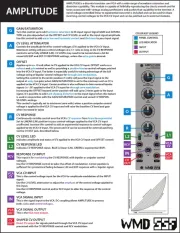
SHELL: Smoothly interpolate be-
tween 32 different shell models.
Each shell model determines the
harmonics of the sound, with in-
teraction from OVERTONE and
DECAY: Controls the decay param-
ter of the internal envelope. The
envelope will remain open as long
as one of the triggger inputs, HEAD
VELOCITY: Add life to your drum
hits with this control. Low veloc-
ity results in softer hits with less
noise and less overtones, while
high velocities punch harder and
ring out longer. Velocity is xed
around 80% max when no cable is
plugged into the CV jack.
SNARES: Control the damping lev-
el of the noisy shell harmonics. In-
creasing this control will decrease
damping, making the drum hit
more noisy and making the noise
all hits will be slightly increased in de-
cay, amplitude, and velocity.
WRECK: This switch and cv input
allow you to distort the sound in
various ways. When no cable is
plugged into the WRECK cv jack a
xed amount of distortion will be
applied. The rst, fully left, posi-
tion is volume with hard clipping.
When no cable is plugged into the
WRECK jack, this is effectively a
clean setting. The middle setting
enables a wavefolder, and the far
right setting enables a distortion
based on quantization error.
MODEL: Select from three models.
Repeatable digital noise that pro-
duces the same sound on every
trigger. Analog noise, that gives a
slightly different sound with each
hit. And nally, a pitch shifting
mode controlled by PITCH that al-
lows you to take your sound into
LOW TUNE: Set the fundamental
frequency of the snare drum. Cor-
responding CV is labeled LO TUNE.
PITCH: Apply an offset to some of
the shell’s harmonics allowing for
ner control of the OVERTONE and
OVERTONE: Control the damping
level of the clean shell harmon-
ics. Increasing this control will de-
crease damping, making the drum
hit more resonant as the harmon-
ics ring louder and longer.
HEAD / RIM: The HEAD and RIM inputs
trigger their own respective exciter that
enters the model at different points.
HEAD mimics striking a snare drum in
the center, and RIM mimics striking the
rim for a sidestick sound. Striking them
at the same time enables a third exciter
and produces a rim shot sound.