Plan the installation Install the Speed Sensor
Drill with 22 mm (7/8”) and
High quality marine grade above/
below waterline caulking compound
4 stainless steel wood screws 19 mm
The Speed Sensor converts analog speed data to the NMEA 2000
You should read all of the installation instructions
before proceeding. Decide where to install all components
before drilling any holes in your vessel.
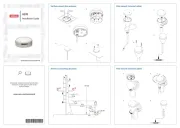
Once you’ve determined the proper location for the unit, place
the sensor on the transom with the bracket flush with the
hull’s bottom. Using the sensor as a template, mark the hull for
the screws’ pilot holes (1). Drill four 3 mm (1/8” ) holes, one in
each end of the slots (2). Mount the sensor to the hull using #8
stainless steel wood screws (3). Use a high quality, marine grade
above- or below-waterline sealant to seal the screws. Make sure
the sensor is flush with the bottom of the hull and tighten the
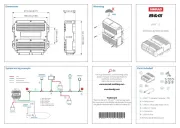
A Paddle wheel with speed sensor
To install the speed sensor, first find a location on the boat’s
transom where the water flow is smoothest. Don’t mount the
sensor behind strakes or ribs. These will disturb the water flow to
the speed sensor. Make sure the sensor will remain in the water
when the boat is on plane. Also make sure the location doesn’t
interfere with the boat’s trailer. Typically, the sensor is mounted
about one foot to the side of the transom’s centerline.
If the base of the transom has a radius, fill the gap between the
transom and the sensor with sealant. This will help ensure a
If you drill a hole in the transom for the cable, make
sure it is located above the waterline. After installation,
be sure to seal the cable hole with the same marine grade
above-or below-waterline sealant used for the screws.
Connect the Speed Sensor to the network
A Paddle wheel with speed sensor
C NMEA 2000 CAN bus backbone
D 12 V DC Power supply. Connect via a switch and 5 amp fuse
Speed Range between 0 and 80 km/h.
59392 – ISO Acknowledgment
60928 – ISO Address Claim
126996 – Product Information
128259 - Speed, Water Referenced