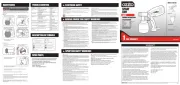
STANDARD EQUIPMENT
INSTRUCTION MANUAL
SPECIFICATIONS
Input: 18V
Max. Flow Rate: 650 ml/min
Max. Viscosity: 60 DIN-s
Pot Capacity: 1L
Nozzle Sizes: Ø2.0, Ø2.5mm
Weight: 1.2kg
ozito.com.au
PAINT
SPRAYER
PXSGS-018
1224
SPRAY GUN SAFETY WARNINGS
WARNING! This appliance is not intended for use by persons (including children) with
reduced physical, sensory or mental capabilities, or lack of experience and knowledge,
unless they have been given supervision or instruction concerning use of the appliance by
a person responsible for their safety.
• NEVER under any circumstances aim the nozzle at another person or animal.
• In the event of an injury occurring, seek medical advice immediately.
• The spray gun must not be used for spraying flammable paints and solvents with a flash
point of less than 21ºC.
• Always ensure there is adequate ventilation when spraying.
• The use of ear protection is recommended.
• Eye protection is recommended to keep hazardous vapours and liquids out of eyes.
• Always wear a face mask when spraying.
• Always read the paint manufacturers thinning instructions before using.
• Never allow the spray to come in direct contact with the skin.
• Never immerse the spray gun in liquid. This could lead to electric shock, personal injury and
material damage.
• NEVER spray near a naked flame, including an appliance pilot light.
• NEVER smoke whilst spraying.
• NEVER allow children to operate or play with the spray gun.
• Before cleaning, always disconnect the battery from the tool.
• Always disconnect the battery when refilling the paint pot.
• After every use ensure you clean your spray gun thoroughly.
• NEVER use the spray gun outside when it is raining.
• Ensure the battery cover is used with tha paint sprayer at all times.
Cordless Outdoor Spray Gun
Viscosity Measuring Cup,
Cleaning Needle, & Cleaning
Brush
DESCRIPTION OF SYMBOLS
V
Volts
W
Watts
A Amperes DIN-s
L
DIN seconds
Millilitres per minute
Litres
Warning
Read instruction manual
Regulatory Compliance Mark (RCM)
Wear eye, ear & respiratory
protection
ml/min
Power tools that are no longer usable should not be disposed
of with household waste but in an environmentally friendly
way. Please recycle where facilities exist. Check with your local
council authority for recycling advice.
Recycling packaging reduces the need for landll and raw
materials. Reuse of recycled material decreases pollution in the
environment. Please recycle packaging where facilities exist.
Check with your local council authority for recycling advice.
CARING FOR THE ENVIRONMENT
SPARE PARTS
Spare parts can be ordered from the Special Orders
Desk at your local Bunnings Warehouse.
For further information, or any parts not listed here,
visit www.ozito.com.au or contact Ozito Customer
Service:
Australia 1800 069 486
New Zealand 0508 069 486
E-mail: enquiries@ozito.com.au
IN ORDER TO MAKE A CLAIM UNDER THIS WARRANTY YOU
MUST RETURN THE PRODUCT TO YOUR NEAREST BUNNINGS
WAREHOUSE WITH YOUR BUNNINGS REGISTER RECEIPT. PRIOR TO
RETURNING YOUR PRODUCT FOR WARRANTY PLEASE TELEPHONE
OUR CUSTOMER SERVICE HELPLINE:
Australia 1800 069 486
New Zealand 0508 069 486
WARRANTY
TO ENSURE A SPEEDY RESPONSE PLEASE HAVE THE MODEL
NUMBER AND DATE OF PURCHASE AVAILABLE. A CUSTOMER
SERVICE REPRESENTATIVE WILL TAKE YOUR CALL AND
ANSWER ANY QUESTIONS YOU MAY HAVE RELATING TO THE
WARRANTY POLICY OR PROCEDURE.
The benets provided under this warranty are in addition to other rights and
remedies which are available to you at law.
Our goods come with guarantees that cannot be excluded at law. You are entitled to
a replacement or refund for a major failure and for compensation for any other
reasonably foreseeable loss or damage. You are also entitled to have the goods
repaired or replaced if the goods fail to be of acceptable quality and the failure
does not amount to a major failure.
Generally you will be responsible for all costs associated with a claim under this
warranty, however, where you have suffered any additional direct loss as a result of
a defective product you may be able to claim such expenses by contacting our
customer service helpline above.
WARNING
The following actions will result in the warranty being
void.
• If the tool has been operated on a supply voltage other than that specied
on the tool.
• If the tool shows signs of damage or defects caused by or resulting from
abuse, accidents or alterations.
• Failure to perform maintenance as set out within the instruction manual.
• If the tool is disassembled or tampered with in any way.
5 YEAR REPLACEMENT WARRANTY
Your Product is guaranteed for a period of 60 months from the original date of
purchase and is intended for DIY (Do It Yourself) use only. If a product is defective it
will be replaced in accordance with the terms of this warranty. Lithium Ion
batteries and chargers are covered by a 36 month
warranty and are excluded from the warranty extension. Warranty excludes
consumable parts.
MAINTENANCE
6. TROUBLESHOOTING 7. CLEANING
Problem Cause Remedy
Little or no
material ow
Nozzle / Suction tube clogged Clean
Spray regulator dial too low Increase regulator dial
Suction tube loose Ret suction tube
No pressure build up in paint pot Tighten paint pot
Material is too viscous for nozzle Swap to the larger Ø
nozzle
Material
leaking
Nozzle loose Tighten
Nozzle worn Replace
Material build up on air cap and
nozzle
Clean
Atomization
is too coarse
Viscosity of material too high Thin material
Material volume too large Decrease spray regulator
dial
Nozzle clogged Clean or replace
Too little pressure build up in
container
Tighten paint pot
Spray jet
pulsates
Material in paint pot running out Rell
Pattern runs
or sags
Applying to much material Decrease spray
regulator dial or increase
movement speed
Too much
overspray
Gun too far from spray object Reduce distance
Too much material applied Decrease spray regulator
dial
Pattern is
very light and
splotchy
Moving the spray gun too fast Decrease spray regulator
dial or decrease
movement speed
Excessive
spitting
during start
up
Too large spray nozzle Try using a smaller size
nozzle and spray on scrap
piece of material.
If the issue re-occurs, try
depressing the trigger
halfway for 3-5 seconds
before fully depressing
the trigger to start the
paint ow.
WARNING! ENSURE THE TOOL IS SWITCHED
OFF AND THE BATTERY IS REMOVED BEFORE
PERFORMING ANY OF THE FOLLOWING TASKS.
Water Vs Oil Based Coating Materials
After each use it is essential that the spray gun is cleaned thoroughly. This
will prevent any blockages from occurring and ensure reliable performance
when you next come to use it.
If coating material was water based (acrylic paint), use ONLY water
when performing the cleaning procedure. Use of solvent based cleaning
materials on water based paints will result in a new substance that will be
extremely difcult to clean.
If coating material was oil based (enamel paint etc.) use ONLY the
appropriate cleaning solution. Read the cleaning instructions printed on the
coating material’s label to determine which cleaning material you need. The
following solvent based cleaning products are safe to use in this spray gun:
• Mineral Turpentine
• Paint Thinner
Flushing The System
1. Unscrew the Paint Pot and return
any remaining coating material
into a container for storage or
proper disposal.
2. Clean the Paint Pot and Suction
Tube with the Cleaning Brush
and solvent/water depending
on the type of coating material
previously used in the Spray Gun.
Note: Only use solvents with a
ash point over 21°C
3. Rell the Paint Pot with fresh
solvent/water and then screw
the Pot back onto the Spray
Head.
4. Spray the water/solvent through
the system into an empty
container. Repeat this step as
necessary until the water/solvent
coming out of the Spray Gun runs
clear.
5. Remove the Paint Pot and empty out any remaining solvent.
Note: Do not pour solvent or contaminated water down the drain as doing
so could pollute our water systems. Always dispose of waste material in an
appropriate and responsible manner.
Cleaning The Parts
1. Unscrew the Nozzle lid from the
Spray Head and disassemble the
Nozzle parts.
2. Push the uid needle adapter
onto the uid needle. Twist and
pull to remove the uid needle.
Note: The ring end of the
Cleaning Brush/Needle can be used
to hook and pull out the Nozzle if it
is stuck.
3. Remove the Suction Tube and
seal.
4. Dip a clean rag in water/solvent and clean the nozzle lid, Nozzle parts,
Spray Gun housing, rear of the Paint Head and Suction Tube.
Note: Use the Cleaning Needle to remove any clogged parts on the unit.
5. Ensure all parts are clean and dry before re-assembling and storing the
paint gun.
General Tool Care
• Keep the vents of the spray gun clean at all times. If possible, prevent
foreign matter from entering the vents.
• If the body of the spray gun requires cleaning, use a moist soft cloth
dipped in water/solvent. Never let any liquid get inside the gun body;
never immerse any part of the spray gun into a liquid.
Note: Ozito Industries will not be responsible for any damage or injuries
caused by the repair of the sander by an unauthorised person or by
mishandling of the spray gun.
OZITO 25 Fox Drive, Dandenong South, Victoria, Australia 3175.
ELECTRICAL SAFETY
GENERAL POWER TOOL SAFETY WARNINGS
WARNING! Read all safety warnings and all instructions. Failure to follow the
warnings and instructions may result in electric shock, fire and/or serious injury.
Save all warnings and instructions for future reference. The term “power tool” in the
warnings refers to your mains-operated (corded) power tool or battery-operated (cordless)
power tool.
1. Work area safety
a. Keep work area clean and well lit. Cluttered or dark areas invite accidents.
b. Do not operate power tools in explosive atmospheres, such as in the presence of flammable
liquids, gases or dust. Power tools create sparks which may ignite the dust or fumes.
c. Keep children and bystanders away while operating a power tool. Distractions can cause you
to lose control.
2. Electrical safety
a. Power tool plugs must match the outlet. Never modify the plug in any way. Do not use any
adapter plugs with earthed (grounded) power tools. Unmodified plugs and matching outlets will
reduce risk of electric shock.
b. Avoid body contact with earthed or grounded surfaces, such as pipes, radiators, ranges and
refrigerators. There is an increased risk of electric shock if your body is earthed or grounded.
c. Do not expose power tools to rain or wet conditions. Water entering a power tool will increase
the risk of electric shock.
d. Do not abuse the cord. Never use the cord for carrying, pulling or unplugging the power tool.
Keep cord away from heat, oil, sharp edges or moving parts. Damaged or entangled cords
increase the risk of electric shock.
e. When operating a power tool outdoors, use an extension cord suitable for outdoor use. Use
of a cord suitable for outdoor use reduces the risk of electric shock.
f. If operating a power tool in a damp location is unavoidable, use a residual current device
(RCD) protected supply. Use of an RCD reduces the risk of electric shock
3. Personal safety
a. Stay alert, watch what you are doing and use common sense when operating a power
tool. Do not use a power tool while you are tired or under the influence of drugs, alcohol or
medication. A moment of inattention while operating power tools may result in serious personal
injury.
b. Use personal protective equipment. Always wear eye protection. Protective equipment such
as dust mask, non-skid safety shoes, hard hat, or hearing protection used for appropriate
conditions will reduce personal injuries.
c. Prevent unintentional starting. Ensure the switch is in the off-position before connecting to
power source and/or battery pack, picking up or carrying the tool. Carrying power tools with
your finger on the switch or energising power tools that have the switch on invites accidents.
d. Remove any adjusting key or wrench before turning the power tool on. A wrench or a key left
attached to a rotating part of the power tool may result in personal injury.
e. Do not overreach. Keep proper footing and balance at all times. This enables better control of
the power tool in unexpected situations.
f. Dress properly. Do not wear loose clothing or jewellery. Keep your hair, clothing and gloves away
from moving parts. Loose clothes, jewellery or long hair can be caught in moving parts.
g. If devices are provided for the connection of dust extraction and collection facilities, ensure
these are connected and properly used. Use of dust collection can reduce dust-related
hazards.
h. Do not let familiarity gained from frequent use of tools allow you to become complacent and
ignore tool safety principles. A careless action can cause severe injury within a fraction of a
second.
4. Power tool use and care
a. Do not force the power tool. Use the correct power tool for your application. The correct
power tool will do the job better and safer at the rate for which it was designed.
b. Do not use the power tool if the switch does not turn it on and off. Any power tool that
cannot be controlled with the switch is dangerous and must be repaired.
c. Disconnect the plug from the power source and/or the battery pack from the power
tool before making any adjustments, changing accessories, or storing power tools. Such
preventive safety measures reduce the risk of starting the power tool accidentally.
d. Store idle power tools out of the reach of children and do not allow persons unfamiliar with
the power tool or these instructions to operate the power tool. Power tools are dangerous in
the hands of untrained users.
e. Maintain power tools. Check for misalignment or binding of moving parts, breakage of parts
and any other condition that may affect the power tool’s operation. If damaged, have the power
tool repaired before use. Many accidents are caused by poorly maintained power tools.
f. Keep cutting tools sharp and clean. Properly maintained cutting tools with sharp cutting edges
are less likely to bind and are easier to control.
g. Use the power tool, accessories and tool bits etc. in accordance with these instructions,
taking into account the working conditions and the work to be performed. Use of the power
tool for operations different from those intended could result in a hazardous situation.
h. Keep handles and grasping surfaces dry, clean and free from oil and grease. Slippery handles
and grasping surfaces do not allow for safe handling and control of the tool in unexpected
situations.
5. Battery tool use and care
a. Recharge only with the charger specified by the manufacturer. A charger that is suitable for
one type of battery pack may create a risk of fire when used with another battery pack.
b. Use power tools only with specifically designated battery packs. Use of any other battery
packs may create a risk of injury and fire.
c. When battery pack is not in use, keep it away from other metal objects, like paper clips,
coins, keys, nails, screws or other small metal objects, that can make a connection from
one terminal to another. Shorting the battery terminals together may cause burns or a fire.
d. Under abusive conditions, liquid may be ejected from the battery; avoid contact. If contact
accidentally occurs, flush with water. If liquid contacts eyes, additionally seek medical help.
Liquid ejected from the battery may cause irritation or burns.
e. Do not use a battery pack or tool that is damaged or modified. Damaged or modified
batteries may exhibit unpredictable behaviour resulting in fire, explosion or risk of injury.
f. Do not expose a battery pack or tool to fire or excessive temperature. Exposure to fire or
temperature above 130°C may cause explosion.
g. Follow all charging instructions and do not charge the battery pack or tool outside the
temperature range specified in the instructions. Charging improperly or at temperatures
outside the specified range may damage the battery and increase the risk of fire.
6. Service
a. Have your power tool serviced by a qualified repair person using only identical replacement
parts. This will ensure that the safety of the power tool is maintained.
b. Never service damaged battery packs. Service of battery packs should only be performed by
the manufacturer or authorized service provider.
2 x Spray Nozzles, Fluide
Needle Adapter
WARNING! When using electric tools basic safety precautions should always be followed
to reduce the risk of fire, electric shock and personal injury.
• Read the whole manual carefully and make sure you know how to switch the tool off in an emergency,
before operating the tool. Save these instructions and other documents supplied with this tool for
future reference.
• This appliance is not intended for use by persons (including children) with reduced physical, sensory
or mental capabilities, or lack of experience and knowledge, unless they have been given supervision
or instruction concerning use of the appliance by a person responsible for their safety. Children should
be supervised to ensure that they do not play with the appliance.
• This appliance is compatible and only to be used with all batteries & chargers from the Ozito PXC
range. Refer to the PXC battery and charger manuals for information regarding charging, use and
storage.
WARNING! Always remove the battery from the tool:
- when the batteries are to be charged,
- when the tool is left unattended,
- when the tool is being checked, cleaned, or having maintenance work done,
- when the tool is to be stored,
- or if the tool vibrates abnormally.
• Do not combine different types of batteries or new and used batteries.
• Do not use modified or damaged batteries.